

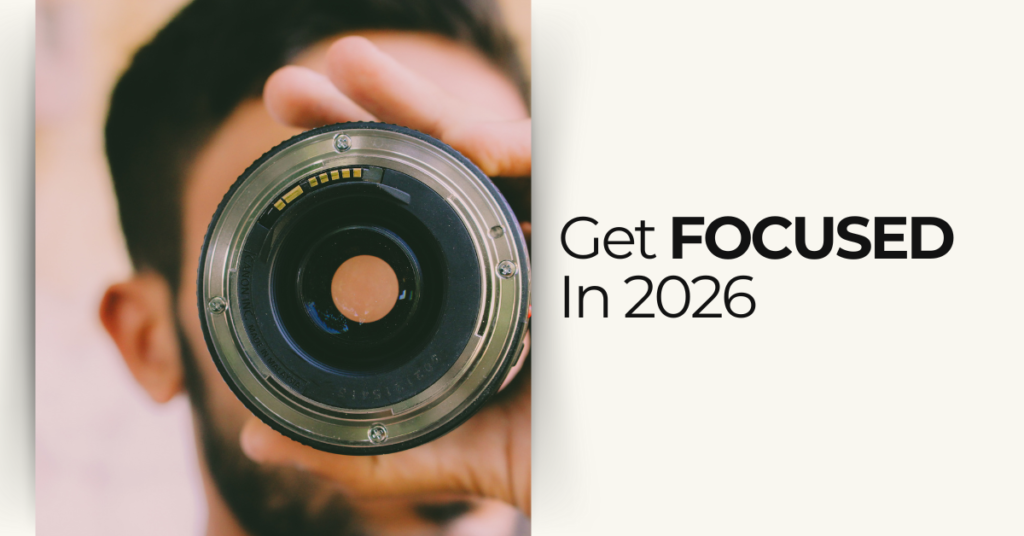
G-E-T F-O-C-U-S-E-D in 2026!
There’s an old adage that goes, “Tell me what you pay attention to and I will tell you who you are.”
No question about it, this observation is a show-stopper.
And perhaps the very best thing about this insight is that it’s absolutely, undeniably, and totally true.
In fact, when asked, many of the very best leaders in the world routinely identify our attention span as the single most important characteristic necessary to engineer extraordinary impact.
Said differently, if you can focus, you can succeed.
Unfortunately, if we’re brutally honest with ourselves, our attention spans probably aren’t what they ought to be.
In fact, a couple of recent studies reinforce this.
For example, in a recent study of office workers, researchers discovered that the typical person can now thoughtfully concentrate on any given task for about three minutes.
Three minutes.
But there’s more.
Another small study of college students found that they can successfully focus on a single task for around 65 seconds.
In the immortal words of Chris Farley, “That’s gonna leave a mark.”
How Did We Get Here?
Without question, the most intelligent (and obvious!) answer is our digital devices.
Think about it.
When it comes to our phones alone, the latest statistics confirm that we are going to pick them up about every seven minutes (which translates into approximately 144 times per day!).
This behavior, in turn, leads to clicking, swiping, and tapping somewhere in the neighborhood of 2,617 times per day.
Now, here’s the rub.
Every single time we do this, not only do we interrupt our focus on the task at hand but we also begin to lose control of our ability to concentrate on anything at all.
And worst of all, for some, this reality may be permanent.
In fact, Cal Newport, author of Deep Work, stated, ““There’s increasing evidence that this shift toward ‘shallow’ [thinking] is not a choice that can be easily reversed. Spend enough time in phrenetic shallowness and you permanently reduce your capacity to do deep work.”
For any leader who’s interested in making a difference (and leaving a legacy), this is a terrifying thought indeed.
It’s Time to G-E-T F-O-C-U-S-E-D
As we begin 2026, make the commitment as a Leader of LIGHT to find your focus, safeguard your health, and maximize your relationships by taking control of your phones and digital devices.
Here’s how.
G = Go Gray and Change Your Display.
If you want to reduce your phone’s attractiveness, change your display to gray and reduce the brightness.
In fact, recent studies have found that switching phones to grayscale alone can significantly decrease the amount of time people spend on their devices. Encouragingly, one study showed a reduction of almost 38 minutes per day when participants did this.
E = Engineer Your Home Screen.
To do this, first revisit the inventory of all the apps you have on your digital device(s). Leave no stone unturned. The key to this step is getting a complete lay of the land.
After compiling a complete list, remove the apps you no longer need.
Then, with the remaining apps, simply rearrange them so that their locations serve you better.
For example, if you are frustrated with spending too much time on social media, you can bury those apps so that they reside on screens that aren’t easy to access.
By having to expend some effort to get to them, you will naturally begin to spend less time viewing social media and more time doing the things you want.
So simple, so powerful.
T = Turn off all non-essential dings, rings, and pings.
Most dings, rings, and pings are your enemy. To combat these crafty intruders, experts suggest that you disable all nonessential digital device notifications.
As a result of fewer dings, rings, and pings in your life, you will find that you can naturally redirect your energy toward the more important things (like finishing career-defining projects; building a supportive circle of friends; or getting back in shape just to mention a few!).
F = Fine Tune Your Tracking.
This just in. People consistently underestimate—usually by about one to two times—how much time they actually spend on their digital devices.
Here’s what this finding means.
If you think you are spending an hour a day on your digital devices, you are most likely spending two to three.
This is a very big miscalculation.
As a result, experts recommend you turn on your digital device’s “time tracking” function.
When you do this, you will get a weekly update of a lot of useful information including your total screen time for the week, your daily average, and how much time you spend on social media and other time-wasters.
O = Optimize Your password.
Here’s an interesting development. Digital device authentication methods that are perceived as less convenient or involve more steps (e.g., typing a numeric password versus using a quick face scan) create what is known as “friction” when you access your digital devices.
Researchers have found that this digital “friction” will not only slow you down, but it will require you to put in significantly more effort when accessing your phone (rather than simply scanning your face). This increased effort, in turn, will discourage frequent, short interactions with your device, leading to less overall use.
C = Converse More, Text Less.
If you are looking to stem the tide of texting (and create better relationships!), here’s a simple approach.
Send your contact list a quick, concise message that reads something like this: “Trying to limit screen time, so texting will be less frequent. Call to chat!”
Or in the case of a work relationship, it could read something like this, “To ensure that we are always on the same page, phone calls are preferred over text discussions. Please call if you need to reach me—and I will do the same.”
The key here is to avoid ambiguity by being kind, clear, and concise. By establishing clear expectations when it comes to texting, not only will you be less distracted, but you also reap the rewards of better, more functional relationships because you’ll be engaging in actual conversations.
U = Unplug in the Presence of Others.
Because your job as a Leader of LIGHT is to bring out the best in others, it’s essential that 100 percent of your attention remains focused on the people around you.
To do this, you’ll need to unplug in the presence of others. This means silencing your phone, putting it in your bag, and/or leaving it in another room.
S = Set Boundaries.
To do this, ask yourself five simple questions:
1. What relationship do I want to have with my digital device?
2. In what circumstances will I silence my digital device?
3. In what circumstances will I stow my digital device in another room?
4. How many times a day will I check my digital device?
5. How many minutes per day will I use my digital device?
E = Eliminate Distractions by Finding Traction.
Put simply, if you want to reduce the amount of time you spend on your digital devices (DIStraction!), you will have to replace that time with something more productive (Traction!).
Said differently, if you don’t find a worthy alternative pursuit, the learned behavior of repeatedly accessing your digital device when you are bored will take over.
So, here’s the question.
What are the things that matter most to you in your life? (And are you willing to let your phone rob you of those things?)
D = Develop the Desire to Read.
There’s nothing more powerful for maximizing your attention span than reading.
Nothing.
But here’s the deal.
We are talking about reading hard copy publications!
In fact, research confirms that leaders who consume information in hard copy format not only have stronger attention spans, but they retain more, and they store it for longer periods of time.
Leading with LIGHT
This year, make it a point to find your focus, safeguard your health, and maximize your relationships.
And the best way to do this is by carefully managing your digital devices.
Don’t miss this.
We aren’t saying jettison your digital devices.
Rather, we’re saying use them wisely and judiciously.
Never forget, in a very real way, our digital devices are a lot like the powerful heating and HVAC systems that are being used in modern skyscrapers.
If we use them well, we can heat the entire structure and bring enjoyment and fulfillment to everyone in the building.
However, if we use these systems recklessly, we are going to burn the entire structure to the ground and there’s going to be a lot of headaches and even more heartache as a result.
Make 2026 your breakout year! And now you have the pathway to do it!
Until next time, See LIGHT, Be LIGHT, and Spread LIGHT.
Until Next Time...
We’ve picked some articles we think you might like! Click below to read more.
Five Ways to Find Your Focus
If you want to be an exceptional leader, you’ll have to come to grips with an indisputable reality. Your energy flows where your attention goes. Said differently, whatever you choose to focus on is where your precious energy will be spent.

What’s Love Got to Do With It?
I think the Beatles had it right. All any of us really needs is love. After all, real love (the kind of love that Leaders of LIGHT possess!) is the one true transformative force that has the power to heal hurts, resolve conflicts, inspire courage, and put the needs of others first.

What’s Your Superpower?
Your superpower is the thing that sets you apart from everyone else. It could be your ability to bring out the best in others. Or it might be your creativity. Maybe it’s your grit, tenacity, and ability to get things done (and done right!). Perhaps it’s your ability to see around corners and identify what the future holds. Whatever it is, rest assured, you have a superpower.
About Lead with Light
Lead with Light is an initiative that aims to equip current and emerging leaders with a reimagined approach to servant leadership.
Our ultimate vision is to grow and develop thousands of Leaders of Light to ignite a movement to see light, be light, and spread light in ways only each can.